Matt’s Forest lake
Ronja, the Robber's DaughterMatt’s Forest lake is a secluded pool in the woods that gives Ronia one of her first experiences of the world beyond Matt’s Fort. It becomes more than a landmark: a place of discovery, bodily freedom, meeting, and seasonal change, where the boundary between human possession and the lives of the forest’s other inhabitants is repeatedly tested.
Setting and First Discovery
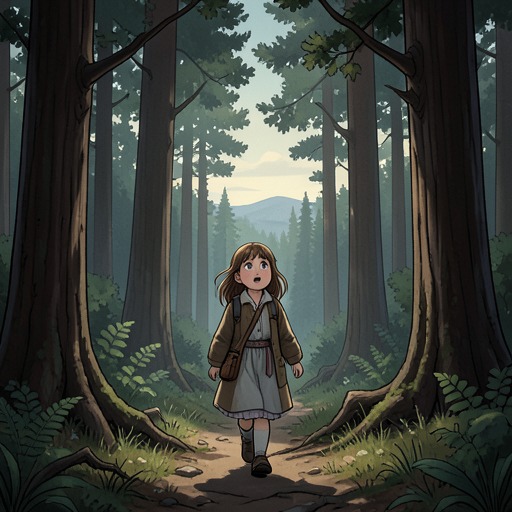
Ronia follows a path into the wildest woods and reaches the lake, the point beyond which Matt has told her not to go. It lies black among dark pines, with white water lilies shining on its surface. She does not know what the flowers are called; she simply marvels that they exist. The lake marks a limit set by her father, but also opens onto a world larger than the stone hall, Matt’s Fort, or Matt’s Mountain—a world she can only begin to understand by seeing it herself.
She spends the day beside the water, throwing pinecones into it and splashing with her feet to make them bob away. Mossy boulders offer climbing, and pine and fir trees give her more to clamber over. After eating the bread and milk she brought, she lies on the moss beneath the rustling trees and falls asleep. Waking in the dark, she sees stars above the treetops and reaches toward them, only to discover another distance she cannot cross. The lake thus anchors an early movement from wonder at what is near to an awareness of how much remains beyond reach; she has also stayed longer than permitted and knows Matt will be beside himself if she does not return.
A Place of Freedom and Repeated Return
The lake remains a destination even as the days shorten. On one visit, its sunlit surface looks like warm gold, though Ronia knows the water is ice-cold. She strips and dives in anyway, shrieking at the shock before laughing and swimming until the chill drives her out. She runs among trees and boulders to warm herself, at first from necessity and then for the pleasure of feeling how easily she can run. Her exuberance ends abruptly when she runs straight into Birk: the forest offers freedom, but it is also where the two children’s paths repeatedly cross.
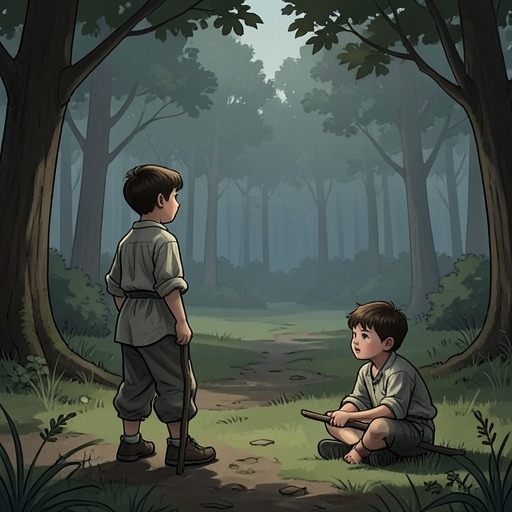
The lake later becomes the place where Ronia finds Birk waiting as promised. He is stretched out on a flat rock in the sunshine; unsure whether he is asleep, she tosses a stone into the water to see if he hears the splash. He springs up and comes to her. His long wait brings her a small, sustaining joy: she has a brother who wants her to come. She dives headfirst into spring, and the lake’s surroundings seem to fill her with the season’s abundance.
Shared Habitat and Seasonal Life
The lake belongs to a larger living landscape, not simply to the children. Birk challenges Ronia’s claim to the woods and to the fox cubs she has followed since their birth: foxes belong to themselves, he argues, and the woods are also home to wolves, bears, elk, wild horses, birds, insects, and other creatures. Ronia knows the animals of the forest, but the exchange makes the meaning of that knowledge sharper: familiarity does not confer ownership. When she and Birk sit quietly in spring, newborn fox cubs play nearby, squirrels move through the treetops, hares cross the moss, and a snake rests in the sun. Neither the children nor the snake disturbs the other. Spring, the scene insists, is for everyone.
The forest also provides practical resources as Ronia and Birk make a life away from the fort. They draw water from a spring, set a net in the river for fish, and gather materials for a hearth and bow. Food changes with the season: flour from home runs out, but fish, forest birds, edible herbs and leaves, and ripe wild strawberries remain available; blueberries are expected next. Their life by the lake and in the surrounding woods depends on attention to what the landscape can provide and when, rather than on a stable store of provisions.
Animals, Use, and Limits
The wild horses make the tension between human desire and animal freedom especially visible. Ronia and Birk want to ride, but Ronia accepts Birk’s objection to taking a horse away from the woods where it belongs. When the horses graze in a nearby glade, the children approach Villain and Savage gently, without success; the animals leave rather than accept their kindness. Later, the horses come to enjoy racing with riders, and the children take long rides through the forest. Their growing partnership with the horses is real, but it does not erase the animals’ capacity to refuse or choose where they go.
Lia, the injured wild mare the children have nursed, provides another measure of that limit. When she is close to having a new foal, her milk dwindles, and Ronia acknowledges that the milk belongs to the foal, not to the children. She thanks Lia and asks Birk to do the same. Lia follows them a little way on the evening they leave, but later answers their calls with a whinny without leaving her herd. She remains a wild horse, not a domestic animal. Meanwhile, Villain and Savage eagerly run to meet Ronia and Birk, whose rides give them shared pleasure. The different responses keep the animals from becoming a single, human-defined category: companionship is possible, but it is not the same as possession.
Seasonal Measure and Significance
The lake and its woods register the passage of the year in changes that affect both feeling and survival. Spring brings newborn animals, fresh grass, and renewed delight in being outdoors; shortening days make the lake’s bright surface deceptive, its cold water a test of Ronia’s daring. Later, summer dies slowly into autumn. The Unearthly Ones’ laments signal that winter is coming, and stubborn rain keeps Ronia and Birk inside Bear’s Cave for days. They cannot keep a fire going in the wet weather; they eventually run in the forest to warm themselves, return soaked, wring out their clothes, and wait beneath fur skins for the sky to brighten. The natural world around the lake is therefore not merely a scenic refuge: its seasons determine what the children can eat, how they move, and how long they can remain outdoors.
Across these returns, Matt’s Forest lake holds together discovery and dependence. Ronia first experiences it as a marvel beyond the limits of her known home; later, it is part of a shared habitat whose creatures do not belong to her, and a point of return for a chosen sibling bond. Its changing water, animals, and weather make the forest’s abundance inseparable from its cold, scarcity, and limits.